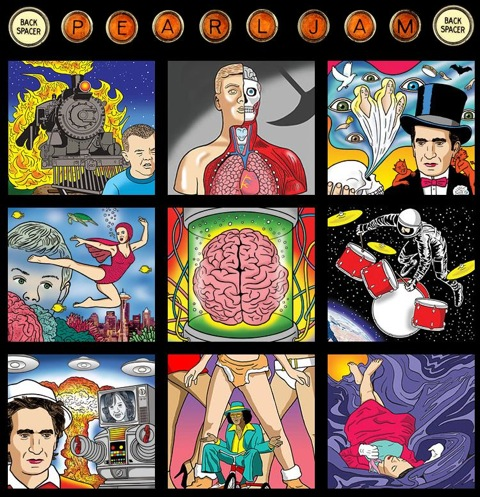
Music Review: Pearl Jam’s “Backspacer”

RATING:  4 / 5 stars

By Chris Moore:

This most recent Pearl Jam release is aptly titled; in many ways, Backspacer is closer in focus and energy to Ten than any of their more recent efforts.

Most reviews have wasted little time in pointing out that this album holds the band’s record for brevity — 37 minutes from the first guitar strum to the final vocal fade.  This can, of course, be interpreted in one of two ways, the worst case scenario being that the album was hurriedly prepared and produced.

This could not be further from the truth.

Backspacer is a strong, purposeful album comprised of eleven very upbeat, very direct tracks that leave little room for the listener to catch his breath over the record’s half hour span.  For the most part, these tight, three minute tracks are energizing and satisfying, catchier and cooler than anything Eddie Vedder and company have turned out in a long time.

This is, of course, a mixed bag.  After all, short, to-the-point pop rock is fun when done properly — which, by the way, it certainly is here.  Still, the electric soundscapes of 2000’s Binaural and the distortion-drenched protest of 2002’s Riot Act were excellent installments in the Pearl Jam catalog, even if their respective values have been minimized by critics who seemed more concerned with comparing them to early releases like Ten and Vs.

It should be noted that 2006’s Pearl Jam lacked cohesiveness as an album, although several songs on that release are among the best of their career (“World Wide Suicide” or “Marker in the Sand,” anyone?).  This eponymous release is an album of wild energy and abandon, which works particularly well in the first half of the track listing.  That being said, Vedder rips his vocal chords to shreds in his effort to sing without holding any emotion or effort in reserve.  This works well in some places, and yet crackles to pieces in others.

Pearl Jam's "Backspacer" (2009)

On Backspacer, Vedder has somehow been able to amp up his emotions and energy, and yet his vocals stand out as some of the best of any Pearl Jam recording to date.  Some songs, like the opener “Gonna See My Friend,” harken back to the roughly shouted vocals of Pearl Jam.  Most, however, feature Vedder at his best.

The opening track is also notable for a strumming pattern that is evocative of some mid-1950s Chuck Berry-esque riffing — with a decidedly grunge rock twist to it, of course.  “Gonna See My Friend” is a catchy track but certainly does not stand out among the other excellent album starters of their career.

From the first millisecond of “Got Some,” there is suddenly evidence that this might be an excellent album.  Jeff Ament’s collaboration with Vedder is a nice addition to the other outstanding Ament contributions — think: “God’s Dice,” “Ghost,” and “Low Light;”  if you’re really kind, forget “Pilate.”  The best part of “Got Some” is that, by the time it has finished, you haven’t even heard the single yet.

“The Fixer” comes next, a tour-de-force taken on very convincingly by Vedder.  I have vacillated about three or four times a day since I picked up the album on Sunday, and I’m still not certain whether I like “Got Some” or “The Fixer” better.  I suppose I’ll just have to keep listening…

As the album continues, there are other rockers performed at breakneck speed (“Johnny Guitar,” “Supersonic”), as well as considerably slower, more instrospective numbers (“Just Breathe,” “The End”).  These latter tracks were clearly influenced by Vedder’s recent solo project, writing and recording the soundtrack for the Sean Penn film Into the Wild.  The fingerpicking patterns that open these songs are reminiscent of his solo tracks, yet these songs clearly show the progress Vedder has made in such a short time, particularly in terms of structure.

For once, I am forced to agree with Rolling Stone‘s assessment of this album.  Their four star rating is a simple means of stating that Backspacer is an excellent album, but not a masterpiece.  From track 6 to “The End,” the album takes some repeated listening to really be appreciated.  At first, I felt that some of these tracks were too tight and traditional to ever truly stand out.  As I’ve listened, more and more of these songs have stood out, like the soaring “Amongst the Waves” and the excellent “Speed of Sound” (listen to Vedder’s vocals in the first few lines as he momentarily invokes Leonard Cohen).

Backspacer may not be the next Ten, but it is silly to even entertain that desire.  (If you read music reviews in the major magazines, you wouldn’t know it though!)  What this release does offer is an energetic, cohesive Pearl Jam album — and that, for me, has always been more than enough.

More album reviews

“I Am Mine” by Pearl Jam – Chords, Tabs, & How to Play

For the cover song music video, CLICK HERE!

“I Am Mine”
Pearl Jam

Intro:  D – F – C – G (x4)

D…   D          F             C               G
The selfish, they’re all standing in line
Faithing and hoping to buy themselves time.
Me, I figure as each breath goes by,
F       G         D
I only own my mind.

The north is to south what the clock is to time.
There’s east and there’s west and there’s everywhere life.
I know I was born, and I know that I’ll die,
The in between is mine.
F G   D
I am mine…

D          G             Am            D
And the feeling, it gets left behind.
All the innocence lost at one time.
Significant, behind the eyes,
D                    Cadd9
There’s no need to hide…
Cadd9           D
We’re safe tonight.

[D – F – C – G (x2)]

The ocean is full cause everyone’s crying.
The full moon is looking for friends at hightide.
The sorrow grows bigger when the sorrow’s denied.
I only know my mind.
I am mine…

And the feeling, it gets left behind.
All the innocence lost at one time.
Significant, behind the eyes,
There’s no need to hide…
We’re safe tonight.

SOLO:
D – F – C – G (repeat)
D…

And the meaning, it gets left behind.
All the innocence broken with lies.
Significance, between the lines.
(We may need to hide)…

And the meanings that get left behind.
All the innocents lost at one time.
We’re all different behind the eyes…
There’s no need to hide.

Outro:
G – Am – D (x3)
G – Am

** These chords and lyrics are interpretations and transcriptions, respectively, and are the sole property of the copyright holder(s). They are posted on this website free of charge for no profit for the purpose of study and commentary, as allowed for under the “fair use” provision of U.S. copyright law, and should only be used for such personal and/or academic work. **

Learn more songs

“Off He Goes” (Pearl Jam Cover)

By Chris Moore:

Hello and welcome to another week and another all-new Monday edition of the Laptop Sessions.  It’s been quite a weekend, and it’s going to be quite a week!

On Friday night, I stayed late at school for as long as I could, but I just couldn’t resist going to see the newly released Star Trek movie.  For once, a movie lived up to the hype!  I picked up Nicole for the trip to the theater, and although we’ve seen a lot of good movies together (not to mention a decent number of flops), this has to top them all.  Although I’m more of a Trek geek than she is, I think it’s fair to say we were equally excited during and after the movie.  If you love the classic series and films, then you’ll appreciate the respect paid to these characters.  If you know nothing about the franchise, then this is the perfect film to watch first.  I can’t wait to find an excuse to watch it again very soon…

Saturday was a crazy day for me, as my sister Jaime graduated from Nyack college at 2 pm in New York.  I got up early (for a Saturday, at least!) and drove to New York for my least favorite of all activities: ceremonies like a graduation.  That being said, it was worth it to see my sister graduate.  We met as a family later on for dinner and that was great, too.  It was great to have Nicole join us, too, and she made what could have been a long, boring drive with lots of downtime an enjoyable little day trip.  Sunday was more of the same, as it was Mother’s Day, and my sister is only home for a week before returning to New York to work.  We got to hang out, talk music, and watch an episode of The Twilight Zone that gave her nightmares as a young child.  We didn’t get to play The Office board game, but there will always be time for another round in the future.  (And I’ll be ready this time! 😉 )

Tonight finds me watching the Mets.  After a seven game winning streak, it appears that they’re going to lose one.  I’m loving this iPhone “MLB.com – At Bat 2009” application.  It makes listening to games and staying in touch with the stats and standings soooo easy.  It’s been a great week for watching Mets baseball, and I don’t want to complain.  But I don’t quite get why they seem unable to score runs when Johan Santana is pitching.  Maybe they get subconsciously complacent, since he’s such a great pitcher.  Even tonight, although he got into a couple sticky situations, he worked his way out of each one — until they pulled him out 1/3 into the seventh inning.  What truly amazes me is his ERA; as of tonight, it is .78!  Games with Santana on the mound would have to get busted open wider than Abyss during a Pay-Per-View for weeks straight for him to reach the ERA’s of the other Mets starters…

But, enough of blogging for blogging’s sake — I should probably introduce the song I’ve recorded for tonight’s acoustic cover song music video.  “Off He Goes” is a track from Pearl Jam’s 1996 album No Code.  This album was the first to break from their previous sound a bit and some fans disapproved.  I’ll admit that it’s not my favorite album in the Pearl Jam catalog by any stretch, but there are some great tracks on it.  “Hail, Hail” is one of the most rocking and catchy songs in their catalog.  “Present Tense” is one of my favorite Pearl Jam tracks, if only for the combination of lyrics and gradual instrumental buildup.  “I’m Open” is a cool spoken-word track — yes, those do exist!

This track, “Off He Goes,” is perfect material for an acoustic cover song.  Initially, after having this song come up on my iPod this weekend, I thought it would be an easy song to record.  Ironically, I almost decided not to learn it and record it for fear of being criticized for recording too many simple songs.

Well, that’s simply not the case…

As Jim can attest to, I spent over an hour and fifteen minutes and about 40-50 takes of this song to get it anywhere near where I wanted it to be.  There are still a couple of discrepancies I hit while singing the tune, but I also nailed a few of my favorite subtleties in the song.  What recording this song taught me was how truly difficult it is to make a slow, deceptively simple song like this really translate into a great performance.  I have even more respect for Eddie Vedder than I did before, especially for the fact that he plays guitar and sings in concert on this one.  The chords are so easy — really, just F, C, and Am — but the strumming pattern was difficult to hit in a few places.  (**The best part about recording these sessions, undoubtedly, is spending all that time, posting on YouTube, and waking up to find that two people have viewed it, one of whom has one-starred it and left no comment.  Thanks for that.**)

That’s enough for one Monday.  I hope you enjoy the session (more than my first YouTube viewer did)

See you next session!

More Laptop Sessions covers

Reflections on Rock Music: How to Become a Songwriter…

By Chris Moore:

Regardless of which genre of rock music you listen to, chances are that you are a fan of songwriters.  As recently as the fifties and even into the sixties, it was considered par for the course to have the songwriting separated from the performance.  For instance, consider Lieber and Stoller’s contributions to Elvis Presley’s catalog.  Johnny Cash wrote some of his songs, but he certainly covered more than he wrote.  And this was an understandable system.

Somewhere along the line, the singer/songwriter became a closely watched and more appreciated commodity.

It really began in the sixties, predominantly with Dylan and the Beatles.  Both acts began by playing traditional music and covers before they started writing their own music.  Whatever it was, something struck them, and from that point forward, it only made sense to record their own material.  This most likely contributed to the legendary heights that sixties rock music reached.  Consider Highway 61 Revisited and Blonde on Blonde, Dylan’s groundbreaking records that truly sounded like nothing that had come before.  Take Revolver and Sgt. Pepper’s Lonely Hearts Club Band, the Beatles’ experimental and, in the case of the latter, concept albums that literally changed the texture of album making as we know it.

Meanwhile, don’t forget all the other singer/songwriters who emerged during that period and since.  Brian Wilson went so far in the mid-sixties as to stop touring and devote his attentions one hundred percent to songwriting and arranging lush, complicated — and, of course, beautiful — background tracks, perhaps best showcased on Pet Sounds and the finally-released SMiLE (the latter of which literally drove him crazy).

Since then, some of my personal favorite bands and individual artists have been, first and foremost, songwriters.  Take Warren Zevon’s unique brand of songwriting, particularly his dark humor and literary references.  Or R.E.M. and their contributions to the genre now known as “alternative rock,” wherein Michael Stipe purposely cut out electric guitar solos and — at least in the band’s early work — muffled the lyrics so that there was no single set of understood words for each song.  It was literally left up for interpretation.

Later acts have split off in a range of directions.  For instance, acts like Ben Folds, the Barenaked Ladies, and the Wallflowers have clearly taken their lead from classic sixties songwriters and then added their own unique lyrical and instrumental twists.  Other bands, such as Pearl Jam and Wilco (to name only a couple), continue to make music that stretches and redefines the boundaries that have previously been set for rock music and songwriting in general.  (This is a painfully short list of five contemporary bands that I love, but they are enough to provide fodder for conversation…)

So, based on this, how does one become a songwriter?

If you’ve always wanted to be a songwriter but were never sure how, or even if you’ve just been curious, then this list is for you…

1)  Rebel Against Something

This is a requisite coming-of-age process for all you prospective songwriters who hope to make it to the big time.  Whether you have grown up in suburbia or on the streets, there are always reasons to rebel.  For Bob Dylan, it was the dull realities of daily life in a dying mining town in Minnesota that caused him to see music as an escape.  He has described his exhilaration as he tuned his radio in to whatever distant stations he could pick up.  Others, such as Eddie Vedder, found music as a way to channel their emotional reactions to what they experienced and witnessed around them.  Vedder reflected on such experiences from young adulthood as abusive relationships, dysfunctional people, and secrets being kept from him.

2)  Show Your Distaste for Tradition and “The Man”

Once you’ve begun the process of rebelling (and perhaps even winning over the masses), it’s time to stick it to “the Man.”  The Beatles’ history epitomizes this development.  They certainly didn’t go from “Can’t Buy Me Love” and “I Want to Hold Your Hand” to “Lucy in the Sky with Diamonds” and “Happiness is a Warm Gun” overnight, but one thing is certain: the more they rebelled, the more fans flocked to Beatlemania.  Bob Dylan brought a giant light bulb to a press conference, refused to communicate in a straightforward manner with any member of the press, and plugged in — full volume — at the Newport Folk Festival.  The Moody Blues promised they would record a classical album, then turned around and used the studio time alotted to them to record their own original material for Days of Future Passed.  Pearl Jam fought the good fight against the “convenience charges” implimented by Ticketmaster, and Eddie Vedder, after a fan threw a copy of Rolling Stone onstage during a concert, wiped his butt with the magazine, explaining to the crowd that RS printed a cover photo of him without the other members of his band in the shot.  When Trent Reznor tired of record label interference and corporate nonsense, the Nine Inch Nails frontman began releasing his music online — including his 2008 album The Slip — for free.

And the list goes on…

Perhaps the best example of the importance of this step in the successful songwriter’s career is found in the Beach Boys’ decision not to play at the 1967 Monterey International Pop Festival.  For the late 1960s and well into the 1970s, they were labeled as “them” instead of “us” by many music fans.  It is arguable that the Beach Boys’ clean cut image that skyrocketed them to success in the early sixties ultimately led to the band’s decline in popularity.  Ah, the irony…

3)  Go Through Rehab

This sounds like a terrible and heartless suggestion to make to you.  Yet, while there are some artists who have not gone through rehab, there are indeed many great musicians and songwriters who have had to face their addictions and other demons at some point in their careers.  Recently, Jeff Tweedy underwent rehabilitation to deal with an addiction to painkillers.  He, like many other artists in the past, was asked what the effect would be on his music.  (I was delighted with his reply — essentially, he said he was feeling better than ever and that his state of mind can only have a positive effect on Wilco’s music.)

Dylan’s 1966 motorcycle crash was asserted by many to be his way of stepping back from the spotlight after a wild tour overseas where he was known to take downers before the acoustic half of his show and then take uppers during the intermission before coming out with the Band.  He was quickly setting a precedent that no individual could survive.  Brian Wilson, of course, withdrew from music and life in general for decades after failing to release SMiLE; it is apparent to anyone who has seen him recently that he still battles with those personal demons.

If not rehab, then every songwriter certainly needs to undergo a period of reflection after a fall from grace.  Take the case of the Barenaked Ladies’ Steven Page, who recently left the band in the aftermath of his cocaine bust.  To read many so-called fans’ scathing rants against him online, you would think you had stepped back into Puritan times.

(Still, I can imagine that he will only be stronger for the experience, and I can’t wait to hear what his next album will be like…)

4)  Have a Family Period

As a songwriter, you may lead the life of a rock star for a matter of years, but eventually everyone has to bring it all back home.  This is the point at which you must find a wife, have one or more kids, and attempt (probably unsuccessfully) to live an ordinary, anonymous life for a while.  The most notable example of this truth is Paul McCartney whose utter failure to accomplish domestic normalcy has been given a name.  It’s called Wings, his band for much of the seventies.  The lineup, much to the chagrin of his earlier fans,  included his wife, Linda.  The lyrical content was often nonsensical enough to make even the most gullible, innocent three year old ask, “What the hell is that supposed to mean?”  And yet this is a rite of passage for all music fans, as well.  We’ve all gone through a Wings phase.  Go on, you can admit it…

The Barenaked Ladies have been in a family phase for years, evidenced most recently by the masterful Snacktime.  Ben Folds briefly indulged in the “normalcy” of family life, recording such simple, touching songs as “Gracie,” but his 2008 album Way to Normal strongly suggests that he’ll be a bachelor for some time to come.  Dylan’s so-called family period lasted from the aforementioned motorcycle crash until about 1974 when he apparently got the itch to tour and record music again.  As he sings in the Planet Waves deep track “Something There Is About You,” “I can say that I’ll be faithful.  I can say it in one sweet, easy breath.  But to you that would be cruelty, and to me, it surely would be death.”

Pretty much speaks for itself…

5)  Um… Continue to Write Songs!

So, after all these steps, phases, and experiences, what’s a songwriter to do?

Continue to write songs, of course!

At this point, you can pretty much choose career paths from a plethora of options.  For instance, you could “find religion” and record a series of records devoted to expressing your spirituality.  You could get more personal and vulnerable by going acoustic for an album, or for that matter, turn to harder rock and roll to showcase your newfound rage over a breakup.  Why not record music for a different genre?  (I would recommend country music, as that seems to be the going trend these days.)  Oh, and don’t forget to release an album exclusively through Wal-Mart, although that’s probably best reserved for a planned reunion or comeback album.  In the meantime, you can always record four non-album tracks per release and split them up, offering one exclusively at iTunes, Target, Best Buy, and Wal-Mart respectively.  It may seem like you’re screwing the fans at the time, but don’t worry; you’ll eventually release a rarities CD that will contain all the non-album tracks.  Put your heart into those non-album tracks now, as there’s nothing more disappointing — and perhaps more predictable — than a sub-par rarities compilation.  Consider it an investment in the future… a future in which you may be writing songs more slowly than ever and yet still be in need of a record to satisfy your contract.

If none of that works, you can take a break from writing for a while to work on covers.  Record a traditional album?  Contribute to a compilation of covers for a famous artist?  Join a supergroup?

The opportunities and options are endless…

Whatever you do, don’t stop caring about what you’re writing and recording, because you’ll always have a fanbase out there that will buy whatever you put out, be it a masterpiece or a recording unworthy of serving even as a paperweight.

So, good luck, and we’re all counting on you!

Related posts